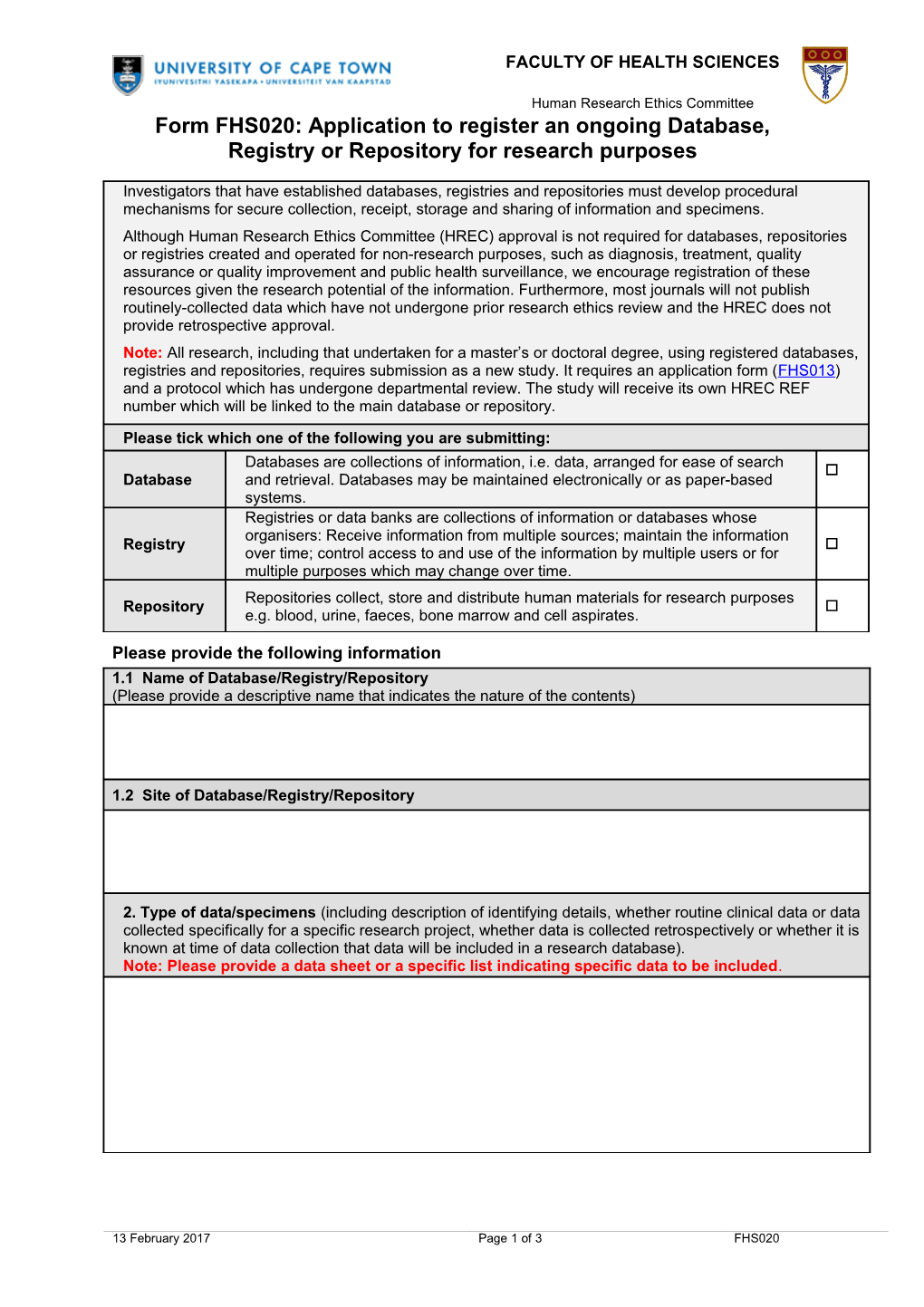
Form FHS020: Application to register an ongoingDatabase, Registry or Repository for research purposes
Investigators that have established databases, registries and repositories must develop procedural mechanisms for secure collection, receipt, storage and sharing of information and specimens.Although Human Research Ethics Committee (HREC) approval is not required for databases, repositories or registries created and operated for non-research purposes, such as diagnosis, treatment, quality assurance or quality improvement and public health surveillance, we encourage registration of these resources given the research potential of the information. Furthermore, most journals will not publish routinely-collected data which have not undergone prior research ethics review and the HREC does not provide retrospective approval.
Note:All research, including that undertaken for a master’s or doctoral degree, using registered databases, registries and repositories, requires submission as a new study. It requires an application form (FHS013) and a protocol which has undergone departmental review. The study will receive its own HREC REF number which will be linked to the main database or repository.
Please tick which one of the following you are submitting:
Database / Databases are collections of information, i.e. data, arranged for ease of search and retrieval. Databases may be maintained electronically or as paper-based systems. /
Registry / Registries or data banks are collections of information or databases whose organisers: Receive information from multiple sources; maintain the information over time; control access to and use of the information by multiple users or for multiple purposes which may change over time. /
Repository / Repositories collect, store and distribute human materials for research purposes e.g. blood, urine, faeces, bone marrow and cell aspirates. /
Please provide the following information
1.1 Name of Database/Registry/Repository
(Please provide a descriptive name that indicates the nature of the contents)
1.2 Site of Database/Registry/Repository
2. Type of data/specimens (including description of identifying details, whether routine clinical data or data collected specifically for a specific research project, whether data is collected retrospectively or whether it is known at time of data collection that data will be included in a research database).
Note: Please provide a data sheetor a specific listindicating specific data to be included.
3. Please describe the physical process by which items will be accepted into the database/registry/repository. For example:
- Patient folders requested and data transposed on to datasheet by research assistant before being entered into Excel spreadsheet.
- Data extracted from Clinicom into spreadsheet by front desk clerk.
- Data entered into database after each patient seen in the clinic.
- Surgical specimens collected from theatre and sent to laboratory for processing and storage in freezer situated at location.
- Blood samples collected by nurse at routine hospital visit and stored at location.
4. Will informed consent be obtained?
In the interest of respect for participants, if data or samples are to be collected prospectively (even if entered at the end of each visit) for future research purposes, then consent (at least simple consent) should be taken. / Yes / / No /
Please attach informed consent documents and list below (if applicable)
Donor/participants’ informed consent guidelines can be found at:
-Databases, Registries and Repositories
5. Please justify if informed consent will not be obtained and why a waiver of informed consentshould be granted.
Important:Even ifData is being collected for routine purposes, this is not a reason to waive consent if data is being collected prospectively.
Note: Obtaining informed consent to use data or specimens stored in a repository created for non-research purposes may be problematic since research was not intended at the time of collection. Where feasible, the Committee may require a researcher to obtain informed consent. However, the Committee may approve a waiver of consent requirements if:
- The research involves no more than minimal risk (e.g. anonymous use of samples); and
- the waiver will not adversely affect participants’ rights and welfare; and
- the research could not practically be carried out without the waiver
6. Please describe procedural mechanisms(receipt, storage, information handling) to protect privacy and confidentiality.
7. Please describe conditions under which data/ specimens may be shared with or released to researchers.
8. For what period will data/specimens be maintained in the database/registry/repository?
9. How will data/specimens be destroyed?
10. Will participants be able to withdraw their data/specimens? / Yes / / No /
11. Applicant details
Title / First name / Surname
Department/Division
Telephone number / E-mail address
Department/office internal mail address for correspondence
Signature
- My signature certifies that I will maintain the database, registry or repository in accordance with the guidelines outlined in the HREC standard operating procedures (
- If at any time I want to share or reuse the information for purposes other than those disclosed in the original approval, I will seek further approval from the HREC.
Signature of applicant / Date
12. Co-investigators
Name / E-mail / Telephone
Name / E-mail / Telephone
Name / E-mail / Telephone
13. Who will be responsible for ensuring that any requests for sharing information meet the database/ registry/ repository’s specifications? (only complete if different from the applicant)
Title / First name / Surname
Telephone / E-mail address
Signature / Date
14. Head of Department or Division (HOD) Signature
I approve the registering of this database, registry or repository in our department.
Signature of Head / Date
Print name
13 February 2017 / Page 1 of 3 / FHS020